
If you work anywhere near affordable housing, you’ve heard it. Probably more than once. Maybe you’ve said it yourself.
‘Rural is too expensive to manage.’
 It comes from funders. From civil servants. From developers. Sometimes even from people inside the housing association sector. And for decades, nobody assembled the evidence to disprove it – so it stuck. It became one of those things ‘everyone knows’.
Here’s the problem with things ‘everyone knows’: when you actually check the numbers, they often turn out to be wrong.
So we checked the numbers
We took the Acuity benchmarking dataset for 2024/25 – 145 housing associations, around 180 performance measures, the most authoritative dataset in the sector. We worked with our friends at Acuity Research & Practice to identify the 11 specialist rural providers in that group, and compared them with everyone else.
We weren’t looking for a particular answer. We just wanted the truth.
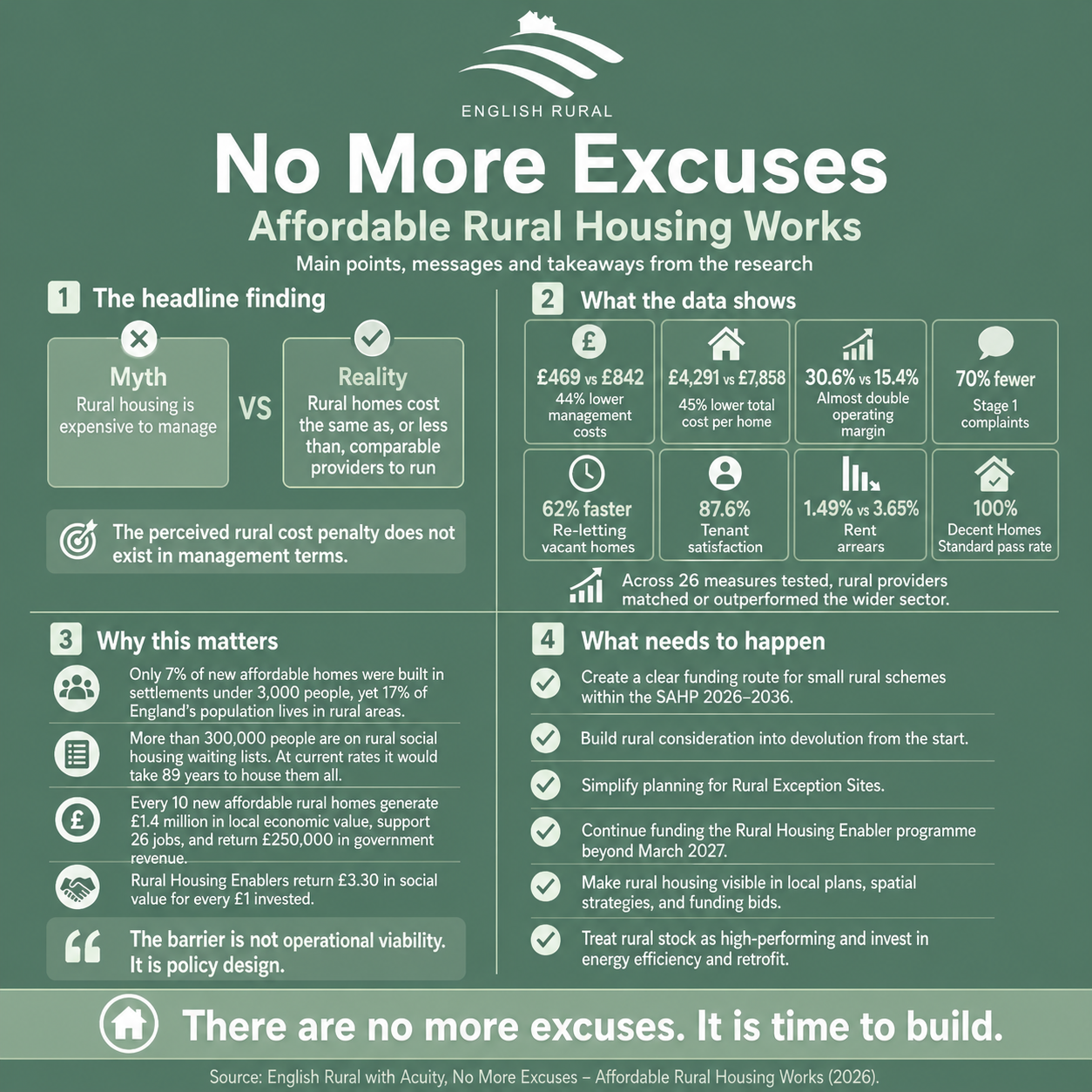
Here’s what the truth looks like:
Of 26 measures we formally tested, 12 showed differences large enough to be statistically significant. In every single one of those cases, the rural group came out ahead.
Why has this myth stuck around for so long?
Partly because building rural homes does cost more – small sites, remote locations, tighter environmental standards, longer lead times. Those are real one-off capital costs.
But somewhere along the way, the cost of building got confused with the cost of running. And that confusion has done enormous damage. It has discouraged investment, constrained grant funding, and given policymakers an easy excuse to look the other way while villages lose their schools, their shops, their key workers, and ultimately their futures.
What the data actually shows
Rural homes aren’t cheaper because they’re rural. When you compare them with closely matched small general-needs providers, the cost gap shrinks and stops being statistically significant.
But – and this is the bit that matters – they aren’t more expensive either. The perceived ‘rural cost penalty’ in management simply does not exist.
Why now?
The Government has just published the £39 billion Social and Affordable Homes Programme 2026-2036, which names rural and community-led housing as priorities. Devolution is reshaping how housing decisions get made. Rural Exception Sites are dramatically under-used. There is, for the first time in years, a genuine window.
Right now in rural England:
And yet every 10 new affordable rural homes generate £1.4 million in economic value, support 26 jobs, and return £250,000 to government. The Rural Housing Enabler programme returns £3.30 of social value for every £1 invested.
This isn’t a marginal investment. It’s one of the highest-return public choices available.
So – no more excuses
If you’re a policymaker, read the report and ask yourself whether the assumptions guiding rural funding decisions are still valid. (Spoiler: they aren’t.)
If you’re a funder, ask whether the evidence supports the way you assess rural schemes.
If you’re another housing association, look at what rural specialists are quietly delivering – and ask whether your portfolio decisions are being guided by data, or by myth.
If you’re a journalist, the story isn’t ‘rural is hard.’ The story is that the sector has been getting it wrong for years, and now we know.
“The evidence is assembled. The case is made. There are no more excuses. It is time to build.”
– Martin Collett, Chief Executive, English Rural
Web accessibility statement © English Rural Housing Association. All rights reserved. Web design and development by Nvisage


