
Rural Housing Week 2026 ran from 6–10 July, organised by the National Housing Federation (NHF), with devolution and the “viability myth” the two defining themes — and English Rural leading both conversations through a new community toolkit and a landmark cost-benchmarking report.
Rural Housing Week is the NHF’s yearly moment to spotlight the social and economic value of affordable homes in the countryside. Around 300 NHF members own and manage more than 1.7 million homes in villages and market towns across England. This year, two themes ran through almost everything: devolution, and the evidence base for rural delivery.
 The devolution focus was no accident. Under the English Devolution and Community Empowerment Act 2026, new strategic authorities — and in many areas directly elected mayors — are taking on significant housing and planning powers. Every strategic authority must now produce a Spatial Development Strategy, a high-level plan with a minimum 20-year horizon. The concern shared across the sector was that unless these strategies explicitly recognise rural need, smaller villages and market towns will be averaged out in favour of larger urban centres.
The NHF ran an online seminar on Tuesday 7 July examining the impact of the new £39bn Social and Affordable Homes Programme (SAHP) 2026–2036 for rural housing, alongside changes to the National Planning Policy Framework. Speakers included English Rural’s Chief Executive Martin Collett, alongside Demelza Jones of the Countryside and Community Research Institute (CCRI), Michael Jones of Broadacres and Susan Tron MBE, Rural Housing Enabler at Durham Community Action. Ahead of the week, NHF Chief Executive Kate Henderson visited Stonewater’s Shiremoor Hill scheme in Merriott, Somerset, where 39 ultra-energy-efficient homes are being built using Travis Perkins’ WholeHouse platform — the UK’s first social housing project to use the system. Henderson said: “Rural communities face some of the most acute affordability pressures in the country. While delivering more affordable homes is vital to sustaining these communities, it’s equally important that the homes we build are fit for the future.”
A policy cloud also hung over the week. In an intervention published in The Guardian on the opening day — and amplified widely across the sector, including by English Rural — the NHF warned that proposed changes to planning rules risk England losing half of all future rural affordable homes. Removing the requirement for medium-sized development sites (10–49 homes) to deliver affordable housing on site could cost an estimated 32,000 new affordable homes over the next decade — a particular threat in rural England, where almost all developments are on medium sites and Section 106 agreements delivered more than half (51%) of rural affordable homes last year. With only 1 in 10 rural homes affordable — half the proportion in urban areas — the Federation is calling on government to protect the mechanism. Professor Nick Gallent of UCL called the proposed change “a real hammer blow” for rural communities.
The statistics circulated during the week painted a consistent picture of acute and worsening need:
More than 300,000 people are on rural social housing waiting lists in England. Rural house prices stand at 8.8 times local lower-quartile earnings. Rural homelessness has risen by 73% since 2018, while social housing construction has fallen by 32% since 2012. Affordable housing need is around 50% higher in rural areas than in urban areas outside London — yet there is no national rural housing target. And just 7% of new affordable homes in 2024–25 were built in settlements of fewer than 3,000 people, even though 17% of England’s population lives in rural areas. The number of rural households on local authority waiting lists grew by 20% between 2021 and 2025 (from 191,092 to 228,404), compared with a 13% rise in urban areas.
A study by Pragmatix Advisory for English Rural, CPRE and the Rural Services Network was widely cited: for every 10 new affordable homes built, the economy is boosted by around £1.4m, 26 jobs are supported and £250,000 in government revenue is generated.
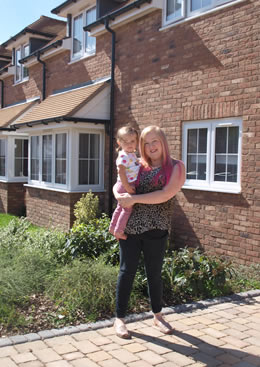
A royal opening at Longstock. The standout moment came on Wednesday 8 July, when English Rural’s Patron, HRH The Princess Royal, officially opened the association’s new affordable homes at Church Fields in Longstock, Hampshire. The scheme was delivered through partnership working between English Rural, Longstock Parish Council, Test Valley Borough Council and the Leckford Estate, with the homes built specifically to meet local housing need and remaining available to people with strong local connections. Stephen Morgan MP, Minister of State for Food Security and Rural Affairs, also attended, meeting residents and stakeholders — including new resident Julie, who welcomed the Minister into her home and shared her experience of living at the development. Martin Collett described the day as “a real highlight of Rural Housing Week”, adding that Longstock is “a powerful example of what’s possible when organisations come together to address an identified local housing need. Developments like this help sustain village schools, support local businesses, strengthen community life and ensure that rural communities remain vibrant and thriving for future generations.”
https://twitter.com/EnglishRural/status/2075148776424067382
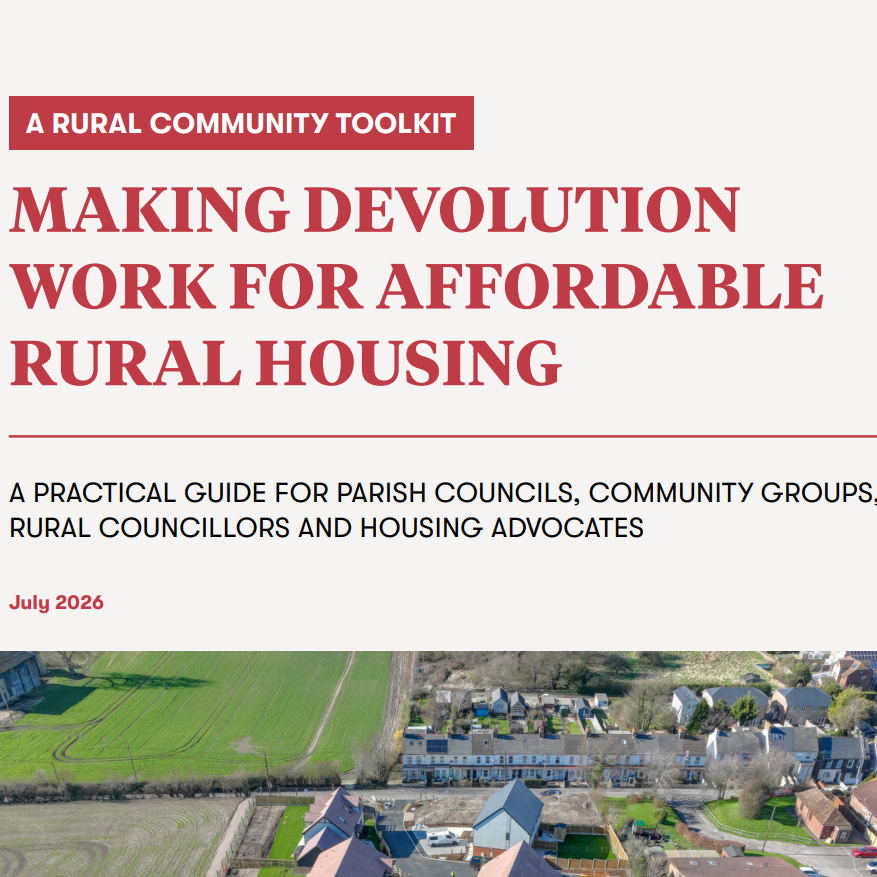
The devolution toolkit. On the first day of the week, English Rural launched Making Devolution Work for Affordable Rural Housing, a free, practical guide for parish councils, community groups, rural councillors and housing advocates. It sets out who communities should engage with, five practical actions, checklists to test whether a local Spatial Development Strategy is genuinely “rural proofed”, and ready-to-use templates including letters to strategic authorities and MPs. The toolkit builds on independent research, English Devolution and Rural Affordable Housing: Opportunities and Risks, published in December 2025 by the Countryside and Community Research Institute (CCRI) at the University of Gloucestershire and commissioned by the Rural Housing Network, which warned of a “postcode lottery” in rural investment. The launch was covered by Housing Digital.
Martin Collett said: “Devolution is the biggest change in how housing decisions are made in a generation, and it could be a real opportunity for rural England. But opportunity is not the same as outcome. Spatial Development Strategies being written now will shape where homes are built for the next 20 years. If rural need isn’t written in, it gets averaged out.” David Barrowcliff, English Rural’s head of communications and technology, added: “We wanted to put something genuinely useful in people’s hands for Rural Housing Week. You don’t need to be a planning expert to make a difference — you need to know who to talk to and what to ask for.”
https://twitter.com/EnglishRural/status/2074038270397157468
The “It’s Coming Home” blog. Borrowing the football chant, English Rural published a reflective blog — “It’s Coming Home: What a Homecoming Really Means in Rural England” — connecting affordable housing to belonging. It argued that for too many people, “coming home” has become “a quiet impossibility”: the grown-up child of a farm worker, the teaching assistant, the carer, the apprentice mechanic, all needed in the village but unable to stay in it. As the piece put it, the challenge is “the difference between leaving and staying. Between visiting and belonging. Between ‘I used to live there’ and ‘I am home’.” It drew on English Rural’s own case studies, including a family priced out of their home village before returning through an affordable home, and a resident who had been living in a horsebox after losing her home and job — “hidden rural homelessness, made visible”.
https://twitter.com/EnglishRural/status/2074400092103069744
Rural exception sites. On Thursday, English Rural published a blog making the case for fuller use of rural exception sites (RES) — a practical planning tool that has existed since 1991 but is still not being used to its full potential. These small sites, usually on the edge of villages, can provide affordable homes for people with a local connection, helping keep families, workers and support networks rooted in the places they know. The blog drew on research by UCL for the Rural Housing Network, which found that only 17% of rural local planning authorities made use of RES — 25 of 145 rural councils between 2021 and 2022, delivering 546 homes — and that around 3,000 additional affordable homes could be delivered each year if councils made fuller use of the mechanism. As the blog put it: “Not huge estates. Not speculative development. Just small, well-planned schemes that help villages stay mixed, sustainable and alive.” It also examined what is getting in the way, what works, and why long-term support for Rural Housing Enablers is so important.
https://twitter.com/EnglishRural/status/2075153736108826707
No More Excuses. Featuring prominently during the week was English Rural’s report No More Excuses: Affordable Rural Housing Works, produced in partnership with Acuity Research & Practice. Drawing on Acuity’s benchmarking data covering 145 housing associations and around 180 performance measures for 2024/25, and comparing specialist rural providers with the rest of the sector, it found rural providers’ management costs 44% lower than the sector average (£469 versus £842 per home), total cost per home 45% lower (£4,291), operating margins almost double (30.6% versus 15.4%), 70% fewer Stage 1 complaints and 88% fewer at Stage 2, 62% faster re-letting, 87.6% tenant satisfaction and a 100% Decent Homes pass rate. Of the 26 measures formally tested, 12 showed statistically significant differences — and in every one, rural providers came out ahead. Collett said: “The so-called ‘viability myth’ around managing affordable rural homes has done enormous damage… The barrier isn’t cost. It’s policy choice. It is time to build.” The report was also covered by Housing Digital and welcomed by ACRE.
https://twitter.com/EnglishRural/status/2051927484753461662
On social media. English Rural ran a coordinated campaign across the week under #RuralHousingWeek on X (@EnglishRural) and LinkedIn, and its content travelled well beyond its own channels.
Monday opened with the toolkit launch across both platforms. On X: “NEW — out today for #RuralHousingWeek. Our FREE toolkit helps rural communities make devolution work for affordable housing. 300,000+ people are on rural social housing waiting lists. Don’t let rural be written out of the plan.” A follow-up thread set out what was inside — “who to talk to, five actions you can take, checklists to ‘rural-proof’ your local plan, and ready-made letters to your MP and strategic authority” — crediting the CCRI and Rural Housing Network research behind it. The LinkedIn launch post was the week’s strongest performer, reaching more than 512,000 impressions and drawing reposts from across the sector. Demelza Jones, the CCRI Research Fellow whose research underpins the toolkit, shared it as “a practical guide for rural advocates and decision-makers to shape devolution in their region into an opportunity.” Martin Collett marked the start of the week with his own post: “The need is clear. The opportunity is here. Now it’s time to turn ambition into homes.”
Tuesday brought the “It’s Coming Home” post, framing the blog for a football-mad summer: “‘It’s coming home’ means more than football… Home is more than a house. It’s belonging. It’s community. It’s having a future where your roots already are.” Wednesday’s Longstock opening generated the week’s warmest engagement, with posts from both English Rural and Martin Collett celebrating the royal visit and ministerial conversation. Thursday’s rural exception sites blog followed — “The land is there. The need is there. The policy is there. So why aren’t we building more affordable homes in rural communities?”
English Rural also amplified partners throughout the week: the NHF’s Guardian warning on planning changes, Rural Housing Week video and webinar promotion, Somerset Council and SHAL’s 14 new affordable homes in Woolavington, Plunkett UK’s placemaking blog, and a widely shared reflection from Project Officer Helen Reedman on the “quiet work” behind rural delivery — “sometimes progress looks like a spreadsheet. Sometimes it looks like listening. Only much later does it become a set of keys to a front door.” NALC, in turn, had earlier spotlighted English Rural’s “No More Excuses” report as challenging “the long-standing belief that affordable rural housing is too expensive to manage.”
ACRE (Action with Communities in Rural England) used the week to call on housing providers, landowners, local authorities and parish councils to work more closely with rural housing enablers. ACRE coordinates the Defra-funded Rural Housing Enabler programme in partnership with its network members, with funding supporting enabler posts across around 90% of the network’s operating areas. An evaluation — commissioned by ACRE from the CCRI and EAP Research Consultancy — found that since 2023, rural housing enablers have supported a pipeline of over 400 rural housing schemes, equating to more than 3,000 potential affordable new homes, with the programme recently extended to 2029, and every £1 invested estimated to generate £3.30 in social outcome benefits. Patrick Mahon, ACRE’s head of policy and public affairs, said rural housing enablers “understand local concerns, help identify the needs of specific communities and bring the right partners together”. ACRE also cited a successful nine-home development at West Farm Close in Eltisley, Cambridgeshire, delivered with Hastoe Housing Association, where residents Patrick and Amanda Fox described their move as “life changing”.
Completions and schemes featured heavily, as captured in the Rural Services Network’s July Spotlight on Rural Housing. Residents began moving into 19 affordable homes at Bomere Heath in Shropshire, delivered by Housing Plus Group with £1.4m of Homes England funding. Willow Tree Housing Partnership was building eight EPC A homes at Shepton Beauchamp in Somerset. Midlands Rural Housing announced a new contract to deliver rural housing enabling across Warwickshire and Solihull. Connexus staff spent a day volunteering with independent living customers in Cleobury Mortimer. Havebury Homes in Suffolk and Coastline Housing in Cornwall marked the week with resident stories and scheme updates. Cambridgeshire ACRE ran a themed blog series exploring the human, behind-the-scenes work of rural housing delivery.
The week closed with a clear message: the evidence is in, the tools exist, and the window to influence devolved decision-making is open now. Spatial Development Strategies are being drafted this year, and English Rural’s free toolkit gives communities a route to engage while the plans are still open. With a national rural housing target still absent from the £39bn programme, and the NPPF threat to medium-sized sites unresolved, the sector’s task is to turn a week of visibility into a year of pressure.
Web accessibility statement © English Rural Housing Association. All rights reserved. Web design and development by Nvisage


